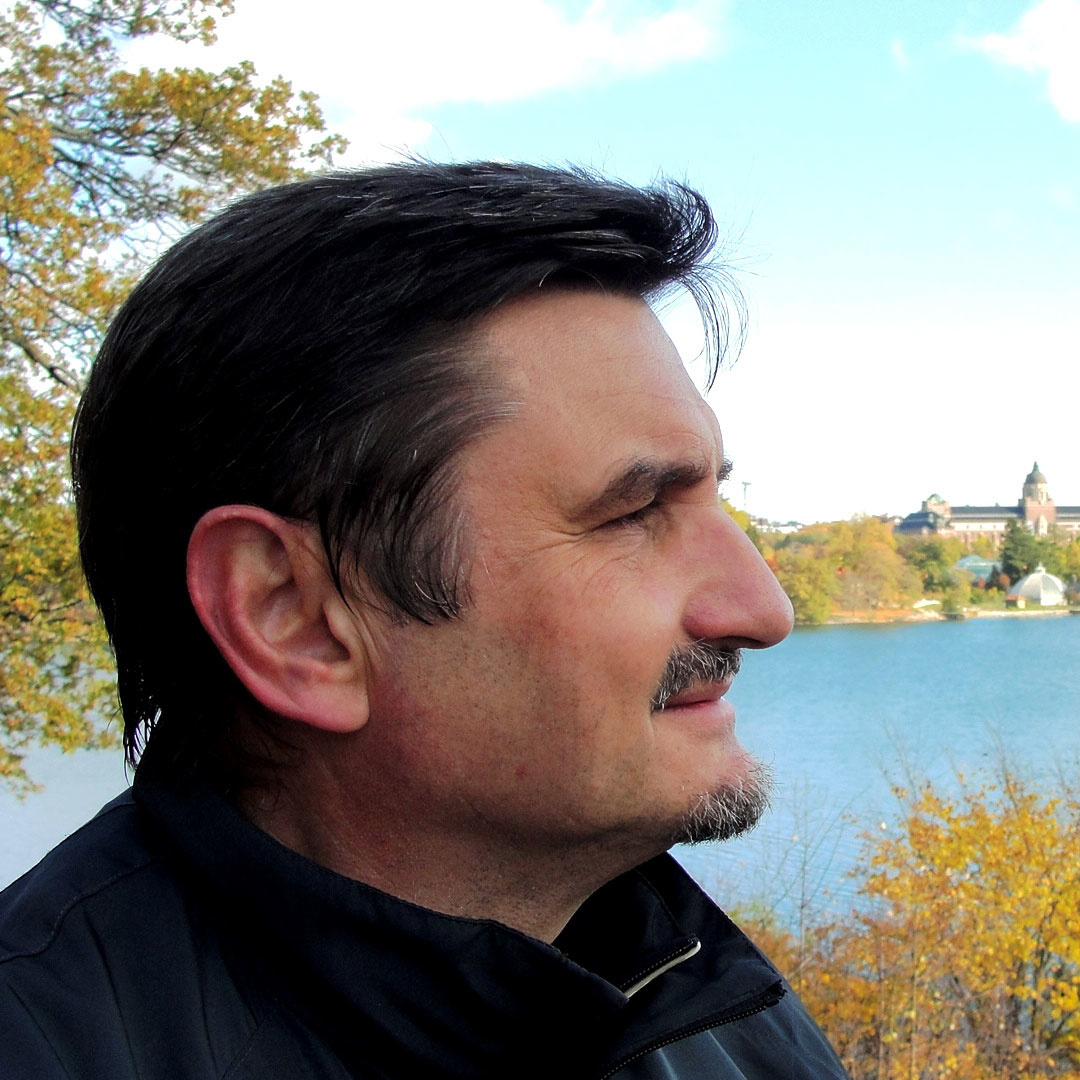
Valentin Goranko (Stockholm University, Sweden) earned his M.Sc. (Mathematics, '84) and Ph.D. (Mathematical Logic, '88) at the University of Sofia "St. Kliment Ohridski". His Ph.D. thesis, "Definability and completeness in multi-modal logics", was supervised by Dimiter Vakarelov, a student of Helena Rasiowa, herself a student of Andrzej Mostowski, who studied under Kazimierz Kuratowski and Alfred Tarski. He has over 30 years of teaching experience in Logic, Mathematics, and Computer Science at universities in Bulgaria, South Africa, Denmark, and Sweden. His research focuses on modal and temporal logics, logics of agency and multi-agent systems, games and logic, and logics of programs, processes, and actions.
Title: The Quest for Ultimate Ignorance: Iterated Ignorance is Complex!
Abstract: This talk is on a project aiming to explore the concept of ultimate ignorance of an agent, depending on the underlying logic of knowledge. By "ultimate ignorance" we formally mean a modal operator obtained by iterating (possibly transfinitely) the ignorance operator I, where Iϕ intuitively says that "The agent is ignorant whether ϕ is true", until stabilisation up to logical equivalence, if that stabilisation ever occurs. In the talk I will explore the logical behaviour of the finite hierarchy of iterated ignorance I, I²,... and its first limit operator Iω and will demonstrate that, contrary to common expectation, that behaviour is generally rather complex, both in terms of the valid consequences between these operators and in terms of the semantic conditions corresponding to the respective implications between them, over relatively weaker underlying logics of knowledge. More specifically, I will focus on the expressiveness of the language L(I, Iω) involving both I and Iω and will first discuss frame correspondences of some simple formulas involving iterated ignorance over some natural frame classes. I will then demonstrate that over reflexive models I is not expressible in monadic second-order logic (MSO) and that the hierarchy of iteration does not stabilize at ω over such models. I will conclude with a brief discussion of some metalogical properties of L(I, Iω) on some natural classes of frames.

María del Rosario Martínez-Ordaz (Czech Academy of Sciences, Prague, Czech Republic) received her Ph.D. in Philosophy of Science from UNAM in 2019. Her dissertation, "Applications of Paraconsistent Tools in the Study of Tolerance towards Contradictions between Theory and Observation", was supervised by Luis Estrada-González. She held postdoctoral fellowships at Nicolaus Copernicus University, the Federal University of Rio de Janeiro, and École Centrale de Lille. Her research focuses on general philosophy of science and philosophy of logic, with interests in the history of science and non-classical logics.
Title: TBA
Abstract: TBA
 Joke Meheus (Ghent University, Belgium) obtained her Ph.D. in 1997 at Ghent University's Centre for Logic and Philosophy of Science, where she continues her research. Her work focuses on the design of non-standard logics and their applications in the philosophy of science, especially the formal study of reasoning and foundational problems in logic. She has also worked on the methodology of scientific discovery, including a book project pursued during a research stay in Pittsburgh. With an earlier ambition to become a professional musician, she retains a strong enthusiasm for teaching and public speaking and views her field as undergoing a particularly creative and transformative period.
Title: From "Most" to "Likely": Adaptive Logics for Qualified Inductive Prediction
Abstract: Reasoning rarely proceeds exclusively with categorical claims. Especially under uncertainty, the claims that enter into our reasoning are often qualified: they may carry, for example, a prevalence qualification such as "most", a likelihood qualification such as "likely", an evidential qualification such as "strongly supported", or a practical-normative qualification such as "provisionally recommended". Such qualifications matter inferentially: they can be strengthened or weakened, they may conflict, and conclusions carrying them can themselves become premises in further reasoning.
In this talk I focus on a basic but pervasive pattern of qualified reasoning: from the claim that an individual a is an F, together with a qualified generalization such as "most Fs are G", we infer a qualified singular conclusion such as "a is likely to be G".
Adaptive logics already provide a general framework for defeasible reasoning in which conclusions may be derived conditionally and later withdrawn when relevant abnormalities are established. They have been applied, among other things, to inductive generalization and abduction. The novelty explored here lies not primarily in this dynamic machinery, but in bringing the qualifications themselves into the object language and into the inferential relations represented by the logic. Rather than defeasibly deriving the unqualified conclusion that a is G, the aim is to derive a qualified conclusion such as "a is likely to be G" from a differently qualified premise such as "most Fs are G". This requires bridging principles between graded prevalence and graded likelihood, and allows the resulting qualified conclusion, including its degree of qualification, to affect subsequent reasoning.
I will explore how such reasoning can be represented within the framework of adaptive logics. This requires extending the underlying logics with generalized quantifiers and graded likelihood operators, and identifying appropriate abnormalities for the defeasible bridging inferences. Further information may rebut a qualified conclusion or undercut the inference supporting it, in which case the conclusion—and further conclusions depending on it—may have to be withdrawn or revised.
A simple running example will be used to discuss the required bridging principles, the logical form of abnormalities, and some complications raised by conflicts between differently qualified claims. I will conclude by indicating how the same framework may extend to argumentative and practical-normative reasoning.

Hitoshi Omori (Tohoku University, Sendai, Japan) is Professor at the Graduate School of Information Sciences, Tohoku University. Previously, he held positions at Ruhr-Universität Bochum and the Japan Advanced Institute of Science and Technology, and postdoctoral appointments at Kyoto University, CUNY, and Kobe University, working with Yasuo Deguchi, Graham Priest, and Makoto Kikuchi. He was also a visiting researcher at Ruhr-Universität Bochum with Heinrich Wansing. Omori received his Ph.D. from the Tokyo Institute of Technology under Toshiharu Waragai. His research focuses on non-classical logic, especially paraconsistent, many-valued, and modal logics.
Title: Gentzen’s idea in view of non-deterministic semantic
Abstract: In the dissertation "Investigations into Logical Deduction", Gentzen introduced systems for logic based on ‘introduction’ and ‘elimination’ rules, and left a remark: "introductions represent the ‘definitions’ of the symbols concerned, and eliminations are no more than the consequences of these definitions." This idea of Gentzen was developed further by Prawitz who added that the introduction rule "may now be taken as the ‘meaning’ of the logical constant," and also explicitly acknowledged that the question arises how to make Gentzen's idea precise since the idea is quite vague. Against this background, the aim of this paper is to have a fresh look at Gentzen's idea from the perspective of non-deterministic semantics, an elegant and natural generalization of many-valued semantics. This is a project with a strong exploratory nature, with interesting implications for both proof-theoretic and model-theoretic semanticists, and I will try to present them without assuming any familiarity with non-deterministic semantics. [Ongoing joint work with Sara Ayhan]
Eugenio Orlandelli (University of Bologna, Italy) received his Ph.D. from the University of Bologna in 2014. From 2014 to 2019 he held a postdoctoral position in the Department of Philosophy and Communication Studies at the University of Bologna, and in 2020 he was a postdoctoral researcher in the Department of Philosophy at the University of Helsinki. He is currently Associate Professor in the Department of Arts at the University of Bologna. He has supervised several bachelor’s, master’s, and Ph.D. students. His research interests include propositional and first-order modal logics, proof theory, labelled sequent calculi, and philosophical logic more broadly.
Title: Intuitionism, cycles, and provability interpretation
Abstract: Cyclic proof theory provides finitary representations of inductive and fixpoint reasoning via non-wellfounded derivations. Provability logics, such as the Gödel–Löb logic GL and its reflexive counterpart Grz, are a natural arena for cyclic methods; yet, although intuitionistic logic embeds into both systems, a fully syntactic (derivation-transforming) proof of faithfulness for the GL embedding has been missing.
We introduce a cyclic sequent calculus for intuitionistic logic and prove, by a direct proof-theoretic argument, that cyclic reasoning is conservative over the standard intuitionistic system. Using cyclic calculi for GL and Grz that eliminate diagonal modal formulas, we then exploit the resulting structural alignment to give uniform, purely syntactic proofs of faithfulness of the provability interpretation of intuitionistic logic into both GL and Grz, avoiding any detour through semantics.

Elaine Pimentel (University College London, UK) is Professor of Logic and Computation at UCL. She received her Ph.D. from the Federal University of Minas Gerais in 2001 and previously taught at UFMG and the Federal University of Rio Grande do Norte. She has held visiting positions at TU Wien, IRIF, École Polytechnique, and the University of Turin. Pimentel has held leadership roles in ACM SIGLOG, the Association for Symbolic Logic, the Brazilian Logic Society, TABLEAUX, and LFMTP, and participates in the European MOSAIC project. Her research focuses on proof theory, verification of computational and logical systems, game semantics, ecumenical logics, and automated reasoning.
Title: Bilateralism with incompatible proofs and refutations
Abstract: Logical bilateralism challenges traditional concepts of logic by treating assertion and denial as independent yet opposed acts. While initially devised to justify classical logic, its constructive variants show that both acts admit intuitionistic interpretations. We will present a bilateral system where a formula cannot be both provable and refutable without contradiction, offering a framework for modelling mathematical proofs and refutations that exclude inconsistency. We formalise the logic via a bilateral natural deduction system with the desirable proof-theoretic properties of normalisation, subformula property and consistency, together with a base-extension semantics grounded in explicit proofs and refutations. Refutation is shown to coincide with Nelson's constructive falsity, extending intuitionistic logic for constructive epistemic reasoning. Finally, we will show how to obtain a well behaved bilateral sequent system and extend the work for the first-order setting.
This is a joint work with Victor Barroso-Nascimento and Maria Osório and Carlos Olarte.